What Is an HDPE Compression Expansion Joint and How Is It Used in Pipeline Systems?
Leave a message
The HDPE (High-Density Polyethylene) Compression Expansion Joint is a key component in modern pipeline systems, providing flexibility and reliable sealing to accommodate thermal expansion, contraction, vibration, and minor misalignments. Widely used in water supply, sewage treatment, chemical transport, and industrial piping, the HDPE compression expansion joint is an essential element for maintaining pipeline integrity and system efficiency. But what exactly is this joint, and how is it applied in practical scenarios?
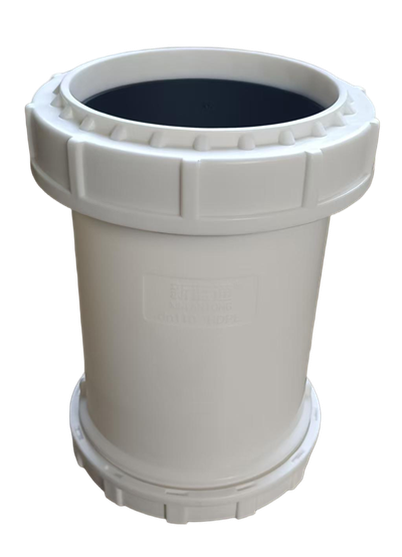
The HDPE compression expansion joint typically consists of three main components: the main body, a sealing ring, and a gland. The main body is a hollow tubular structure, often formed through integral injection molding, which gives it uniform strength and durability. The sealing ring ensures a watertight and pressure-resistant connection between the joint and the pipeline, while the gland compresses the sealing ring, maintaining a secure fit and preventing leaks. This design allows the joint to accommodate axial movement, lateral deflection, and angular rotation, making it highly adaptable to various piping configurations.
There are several types of HDPE compression expansion joints based on their structure and application requirements. Standard joints are suitable for general water supply pipelines and industrial applications, whereas reinforced models may incorporate additional ribs or thicker walls for high-pressure systems. Some variants feature adjustable glands or integrated flanges to simplify installation and enhance compatibility with different pipe diameters. Materials for the sealing ring, typically EPDM or NBR, are selected depending on the fluid being transported, temperature, and chemical resistance requirements. The modularity of the design allows for customization according to project specifications.
Using an HDPE compression expansion joint correctly requires proper installation and maintenance. During installation, the joint must be aligned with the pipeline, ensuring that the sealing ring sits evenly within the gland. Excessive tightening of bolts can deform the sealing ring, reducing its sealing efficiency, whereas insufficient compression may result in leaks. Routine inspection is recommended, particularly in high-pressure or chemical applications, to monitor the condition of the sealing ring and gland assembly. Replacement of worn components is essential for maintaining system integrity and preventing costly downtime.
The industry for HDPE compression expansion joints has seen continuous innovation. Recent developments focus on improving the mechanical strength of the main body, enhancing chemical resistance, and extending the life of sealing components. Advances in injection molding and polymer technology allow for joints that maintain flexibility while withstanding higher pressures and extreme temperatures. Industry news has highlighted the use of HDPE expansion joints in large-scale municipal water projects and chemical transport pipelines, demonstrating their ability to reduce stress on pipelines, minimize leaks, and improve operational safety.
Comparing HDPE compression expansion joints with other types of expansion joints, such as rubber or metal bellows, reveals several advantages. HDPE joints are lightweight, corrosion-resistant, and relatively inexpensive. They require less maintenance than rubber joints and are easier to install than metal bellows in certain applications. However, metal expansion joints may be preferred in extremely high-temperature or high-pressure environments, where HDPE may not meet the mechanical requirements. Choosing the right joint depends on factors such as fluid type, pressure rating, temperature, and installation conditions.
In conclusion, the HDPE compression expansion joint is a versatile and reliable solution for modern pipeline systems, capable of accommodating movement, reducing stress, and ensuring leak-free performance. Understanding its structure, types, proper installation, and recent material innovations enables engineers and maintenance personnel to optimize pipeline performance and extend system lifespan. With ongoing advancements in polymer technology and manufacturing techniques, HDPE compression expansion joints continue to provide efficient, durable, and cost-effective solutions for fluid transport and industrial applications.