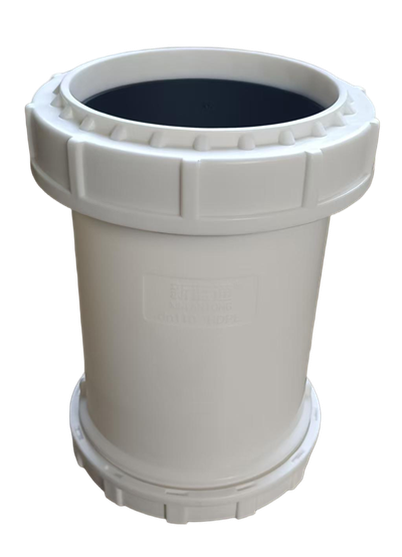
HDPE Reducers: Key Components for Diameter Conversion in Piping Systems
Leave a message
In the design and construction of HDPE piping systems, reducers are crucial components for achieving smooth connections between pipes of different nominal diameters. They play a vital role in regulating flow, matching equipment interfaces, and optimizing pipeline layout. Made from high-density polyethylene (HDPE) as the base material through extrusion or injection molding, they possess the same chemical stability and physical properties as the pipe material, making them widely used in municipal, agricultural, and industrial fluid transportation applications.
The basic structure of an HDPE reducer is a tapered or stepped transition body, with both ends having diameters and port types matching the connected pipe material. Based on shape, they can be divided into concentric reducers and eccentric reducers: Concentric reducers have coincident axes at both ends and are suitable for vertically or symmetrically arranged pipelines, ensuring no significant velocity shift during medium changes in direction; eccentric reducers have parallel axes at both ends but not on the same horizontal plane and are commonly used in horizontally arranged pipelines to avoid air pockets or liquid accumulation at the bottom, ensuring continuous transport and system drainage performance.
In terms of performance, HDPE reducing fittings inherit the excellent chemical corrosion resistance of the pipe material, exhibiting good resistance to acids, alkalis, salts, and most organic solvents. They can maintain structural integrity and reliable sealing in corrosive environments such as sewage, chemical media, and seawater for extended periods. Their good low-temperature toughness prevents brittleness during cold climates or winter construction, ensuring service stability in varying environments. Furthermore, due to their low density and light weight, reducing fittings are easy to transport and install, significantly reducing labor intensity and construction time.
Regarding connections, HDPE reducing fittings can be connected to the pipe material via butt fusion, electrofusion socket, or flange connections. Butt fusion and electrofusion, forming a homogeneous bond, provide interface strength no less than the pipe body, resulting in superior sealing performance, making them particularly suitable for pressure transmission systems. Flange connections facilitate disassembly and maintenance and are commonly used in applications requiring regular maintenance or cross-connection with pipes of other materials. Their coefficient of thermal expansion closely matches that of the pipe material, reducing interface stress caused by temperature changes and improving system reliability in environments with fluctuating temperatures.
In applications, HDPE reducers are widely used in pipe diameter change sections of water supply networks, branch junctions in agricultural irrigation systems, pump inlet and outlet connections in chemical pipelines, and equipment interfaces in industrial cooling circulation systems. They not only solve the connection challenges between pipes of different diameters but also reduce local resistance, energy consumption, and media disturbance through reasonable flow channel design, thereby improving system operating efficiency.
Overall, HDPE reducers, with their advantages of reasonable structure, material compatibility, corrosion resistance, strong connections, and convenient construction, have become an indispensable functional component in HDPE piping systems, providing reliable diameter conversion and system integration solutions for various fluid transportation projects.