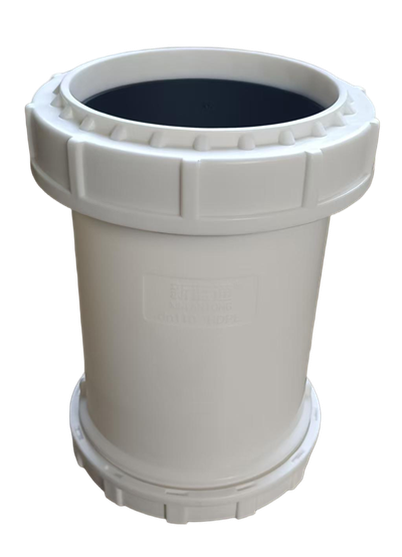
HDPE T-junction Fittings: Efficient Hubs for Multi-directional Connections
Leave a message
In modern water supply, drainage, and fluid transport systems, the connection methods of pipe fittings directly affect the flexibility of pipeline layout and operational reliability.HDPE T-junction fittings, as an important branch of high-density polyethylene (HDPE) material, leverage their unique multi-directional connectivity to become core components for achieving flow branching, merging, and node expansion in complex pipeline systems, playing a crucial role in municipal engineering, building water supply and drainage, and industrial fluid transport.
HDPE T-junction fittings use high-density polyethylene resin as their base material, inheriting the material's inherent advantages of chemical corrosion resistance, impact resistance, and low-temperature resistance. Their stable molecular structure allows for long-term resistance to acid and alkali corrosion from domestic sewage and industrial wastewater, maintaining good mechanical properties even in environments ranging from -40℃ to 60℃, avoiding the drawbacks of metal fittings such as easy corrosion and brittle fracture. Simultaneously, HDPE material is significantly lightweight, with a single piece weighing only 1/5 to 1/3 of a cast iron T-junction of the same specifications, greatly reducing transportation and installation difficulties, making them particularly suitable for construction scenarios at heights or in confined spaces.
From a structural and functional perspective, four-way fittings achieve multi-directional fluid distribution or convergence through four perpendicularly intersecting ports. Common types include equal-diameter four-way fittings and reducing four-way fittings. Equal-diameter four-way fittings can evenly distribute flow, suitable for symmetrical pipe network layouts; reducing four-way fittings, through combinations of different diameters, solve the flow velocity matching problem between main pipes and branch pipes, reducing hydraulic losses. Their port design strictly adheres to fluid mechanics principles, with an inner wall smoothness of Ra0.8 or less. Combined with the low friction coefficient of HDPE, this effectively reduces fluid resistance and improves transport efficiency.
Regarding connection methods, HDPE four-way fittings employ a hot-melt welding process, achieving molecular-level fusion with the same material pipe through heating and melting, forming a seamless, continuous seal. This connection method eliminates the leakage risks of traditional adhesive or flange fixing, and the interface strength is even higher than the pipe body itself, ensuring the sealing reliability of the pipe network under high pressure or vibration environments. For prefabricated buildings and modular construction, its prefabrication characteristics further simplify on-site operations, shorten construction time, and improve system integrity.
Currently, HDPE four-way pipe fittings are widely used in sponge city rainwater pipe networks, building in-floor drainage systems, and chemical media transportation. Their comprehensive advantages of corrosion resistance, lightweight, and high sealing performance are driving the upgrading of pipe network systems towards greater efficiency and durability. With advancements in material modification technology, these pipe fittings are expected to expand their application in larger diameter and higher pressure scenarios in the future, continuously providing robust connection solutions for fluid transportation projects.